Jewelry compresses a great many decisions into a small object. Metal tone, stone choice, band proportion, engraving placement — and each one is being judged at a distance, through a photograph, at an order value that makes a wrong guess expensive for both sides.
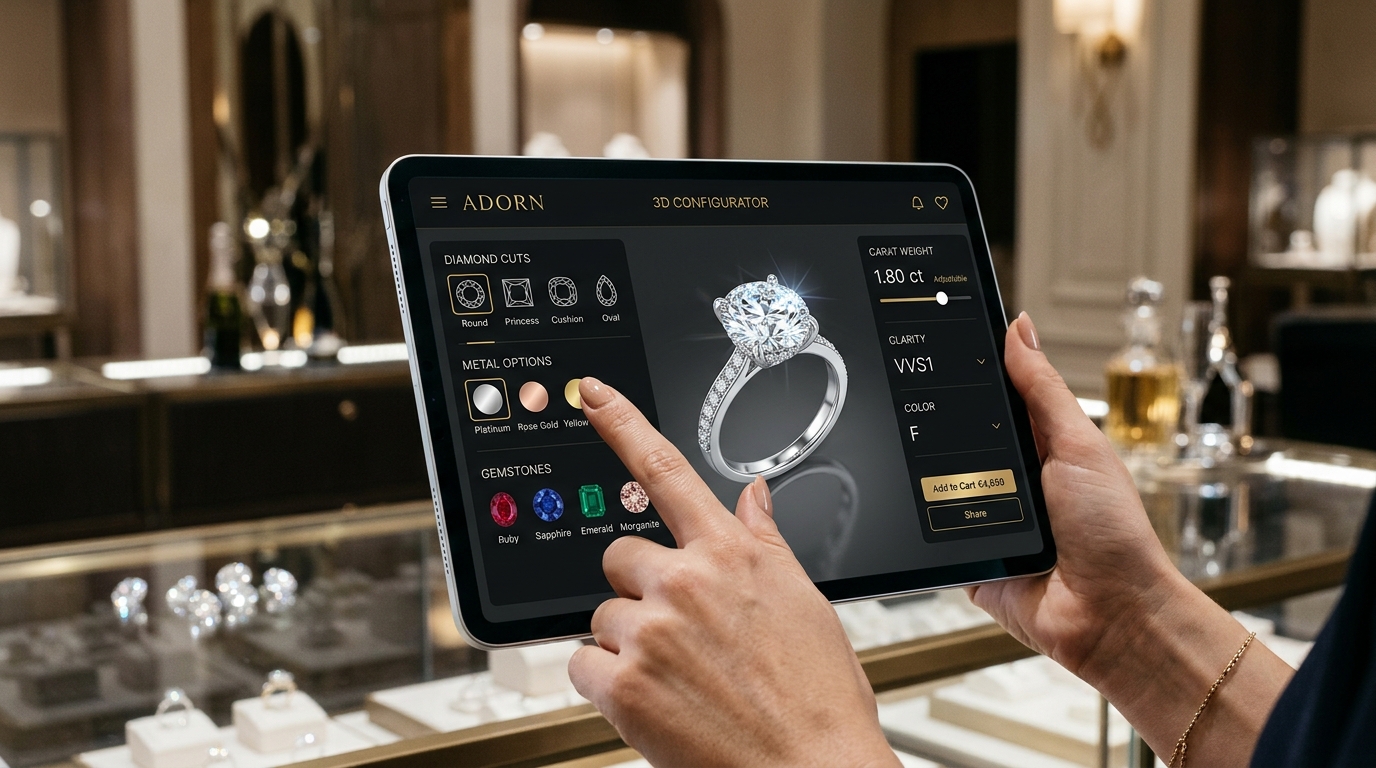
A jewelry 3D configurator puts those decisions on screen. The shopper changes metal, switches the centre stone, positions the engraving, and sees each combination rendered in real time before committing.
This article covers why jewelry is unusually exposed to the expectation problem, how metal and gemstone rendering differs from colour picking, and how to judge whether your catalog justifies one.
Why jewelry is exposed
Two things make jewelry different from most categories.
The order value is high, and so is the cost of a return. A returned ring involves insured shipping in both directions, inspection, potentially re-polishing or re-setting, and a piece that cannot always be resold as new. The National Retail Federation’s 2025 Retail Returns Landscape estimates 19.3% of online sales will be returned in 2025 against $849.9 billion in projected total returns — and notes that 9% of returns are fraudulent. In a category where the average return costs far more than the average parcel, reducing the number of returns matters more than making each one cheaper.
The decision is inherently combinatorial. Buyers are not choosing from a catalog of finished pieces; they are assembling a specific one. “Rose gold, sapphire centre, engraving on the inside band” is a description a photograph cannot hold. It shows one configuration and leaves the rest to the buyer’s imagination — and the imagination is where the mismatch happens.
What the evidence supports
We are deliberate about which figures we publish, because this category attracts a lot of confident claims that do not survive checking.
Shopify publishes merchant case studies on its own domain. In the Rebecca Minkoff case study — a fashion and accessories brand, not a jeweler — shoppers who viewed a product as a 3D model were 44% more likely to add it to cart, and those who viewed it in AR were 65% more likely to make a purchase. That is one merchant’s result in one category adjacent to jewelry, published by Shopify, and it is not our result. We cite it because it is checkable.
What can be said generally is narrower: when a buyer is composing a specific piece and cannot see it composed, some of that uncertainty becomes a return or an abandoned cart. Removing the uncertainty is worthwhile at jewelry price points in a way it is not for a low-value accessory.
How metal and gemstone rendering works
The difference between a configurator worth building and a colour swatch is whether surfaces respond to light.
Metals. White gold, yellow gold and rose gold are not three flat colours — they are three different reflectances. Polished surfaces behave differently from brushed ones. PBR rendering simulates the interaction with light rather than tinting an image, so a band reads as metal rather than as a coloured shape.
Gemstones. Fire and tone shift with the viewing angle. This is precisely where flat photography misleads: a stone photographed under studio light and a stone seen indoors are different experiences, and the gap between them is one of the standard sources of “it looked brighter in the picture”.
Engraving. Text and its position are previewed on the piece rather than described. Buyers choosing an engraving for an occasion generally know what they want to say; what they are less sure about is how it sits on a band at that width.
We build these on WebGL, so they run in the browser with nothing to install — MDN’s WebGL documentation confirms support across all modern browsers. For iOS AR try-on, the asset path is USDZ, which Shopify generates automatically from an uploaded GLB.
What a preview does not fix
Being clear about the limits matters as much as describing the capability.
A configurator does not solve sizing. Ring sizing is a physical measurement problem, and a rendered hand does not tell a buyer whether a size 6 fits. Sizing tools and returns policy address that; a configurator does not.
It does not solve photography of the finished piece either. If your existing product photography is inconsistent in lighting and colour, adding a configurator gives buyers something more reliable to compare against — which tends to make the photography problem more visible, not less.
And it does not replace the trust signals a high-value purchase depends on: certification, provenance, warranty and a returns process a buyer believes in. Those carry weight that no rendering can substitute for. What a configurator does is remove the uncertainty that a photograph cannot resolve, so that the remaining decision rests on the things that should actually decide it.
A short self-assessment
Two or more “yes” answers below suggest a jewelry configurator is worth costing:
- Do your pieces have multiple valid combinations of metal, stone, band style or engraving?
- Is your order value high enough that a single return is painful? In jewelry this is nearly always true.
- Are your returns concentrated around “not as described”, “wrong metal” or “colour mismatch”?
- Do you offer custom or made-to-order pieces that buyers currently cannot preview at all?
A catalog of finished pieces in a single metal is a poor fit. The configuration surface is too small to justify the build.
Build approaches
Subscription apps install quickly and are priced monthly. Their gemstone rendering is typically the weak point — which matters disproportionately here, because if the stone does not read convincingly the preview does not resolve the buyer’s doubt.
Enterprise CPQ platforms are built for very large catalogs and complex pricing rules, licensed and sized accordingly.
Project-based custom development builds around your catalog — your metals, your stones, your engraving options — with the configuration data belonging to you, including any downstream export to production. Where realism is the entire point of the feature, this is usually the route that pays for itself.
Where AR fits
Configuration resolves metal, stone and engraving. It does not resolve how a piece reads on a hand. That is what AR adds, placing the configured piece on the buyer at scale.
It shares the same 3D assets, so it can be added after the configurator rather than built alongside it. Our AR product preview notes cover the platform reality — including that iOS support runs through USDZ rather than WebXR.
FAQ
Which customization dimensions does a jewelry configurator typically cover? Metal, centre stone and its colour, band style, and engraving content and placement. The exact set is defined against your catalog and your manufacturing process before development starts.
Is the gemstone rendering convincing enough to matter? It addresses the specific failure that flat photography produces — a stone that looked bright in a studio image and dull indoors. PBR rendering shows fire and tone shifting with the viewing angle. It does not remove returns caused by sizing or change of mind.
Can it connect to production? For made-to-order pieces, yes. The configuration — metal, stone, engraving — can be exported as structured data rather than re-keyed, which removes the handover step where mis-specified orders originate.
Does it work with Shopify? Yes. The configurator is a browser-native WebGL module embedded on the product detail page, with the configuration flowing into the cart and order. Shopify accepts GLB models up to 500 MB and converts them to USDZ for iOS.
How long does a build take? Catalog size matters, but stone and metal rendering complexity matters more. We scope both before quoting a duration rather than publishing a figure that would not hold.
Next step
The useful starting point is your configured pieces — the ones where buyers ask whether rose gold suits them, or whether a stone will read too dark. Send us that list along with how your metals and stones are structured, and we will tell you what the build involves, or whether a configurator is the wrong spend for your catalog.